
Insights / Selection guide · 2026-10-30
Rigid Chain vs Scissor vs Hydraulic Stage Lifts: How to Choose
Stage lifts, orchestra pit lifts and lift tables are usually driven by one of three principles: a rigid chain that locks into a push column, a scissor mechanism, or hydraulic cylinders. Each can lift a platform; they differ in how much depth they need below the stage, how far they can travel, how several lifting points are kept level and what has to be maintained. This guide compares them on the criteria that decide real projects. Figures for rigid chain systems come from Zhonghui's own 30A–100A and SL500/SL2000 documentation; statements about scissor and hydraulic lifts are general engineering guidance, not data for a particular product. Final selection always follows the drawings approved for a specific venue.
Quick answer
- Limited pit depth, long travel, no oil on stage: look first at a rigid chain lift.
- Short stroke, simple platform, cost-sensitive: a scissor lift table is often enough.
- Very high loads and a plant room or deep pit available: hydraulic lifts remain an option.
- Both stability and low retracted height: consider a scissor-guided rigid chain lift table, where the scissor frame guides and the rigid chains lift.
How each drive works
Rigid chain lift
A rigid chain has links shaped so that, as they leave the drive, they interlock into a solid column that can push as well as pull. When the platform lowers, the links unlock and fold into a chain magazine beside or below the drive. Because the chain is stored instead of telescoped, the closed height stays low while the travel is long. In Zhonghui's range the minimum installation height runs from 200 mm (30A) to 650 mm (100A), rated speeds from 150 mm/s to 300 mm/s, and maximum travel up to 10 m depending on model and load.
Scissor lift
A scissor lift raises the platform by opening crossed arms, driven by a cylinder, screw or motor. It is mechanically simple and inherently guides the platform, but the closed height grows with the stroke: longer travel needs longer arms or several scissor stages stacked on top of each other.
Hydraulic lift
A hydraulic lift pushes the platform with one or more cylinders fed by a power unit. It can carry very high loads, but the cylinders need depth below the platform (or telescopic cylinders), and the system brings hydraulic oil, hoses and a power unit that must be housed and maintained.
Side-by-side comparison
| Criterion | Rigid chain lift | Scissor lift | Hydraulic lift |
|---|---|---|---|
| Retracted height vs travel | Low; chain is stored when retracted (Zhonghui 30A–100A: 200–650 mm minimum installation height) | Grows with stroke; long strokes need multi-stage scissors | Needs cylinder depth or telescopic cylinders below the platform |
| Travel | Up to 10 m depending on model and load (Zhonghui range) | Best suited to short and medium strokes | Long travel possible with deep pits or telescopic cylinders |
| Load | Per chain from 10 kN static (30A) to 200 kN static (100A, at 3.5 m); several chains per platform | Depends on frame size and drive | Very high loads possible |
| Several lifting points | One motor with mechanical shafts, or separate drives synchronised electronically with feedback | Large platforms need several frames tied together | Possible with flow control and position feedback per cylinder |
| Oil on stage | None | Depends on drive (electric or hydraulic) | Hydraulic oil, hoses and power unit |
| Typical use | Stage and orchestra pit lifts, wagons, matrix platforms, industrial lifting with limited height | Short-stroke platforms, loading docks, simple stage risers | Very high loads where a pit or plant room exists |
The hybrid many venues end up with: scissor-guided rigid chain tables
Scissor and rigid chain are not always either/or. A rigid chain is designed to push, not to resist large side loads, so many lift tables combine a scissor frame for guidance and stability with rigid chains that provide the lifting force. The photos below are from our factory run tests.
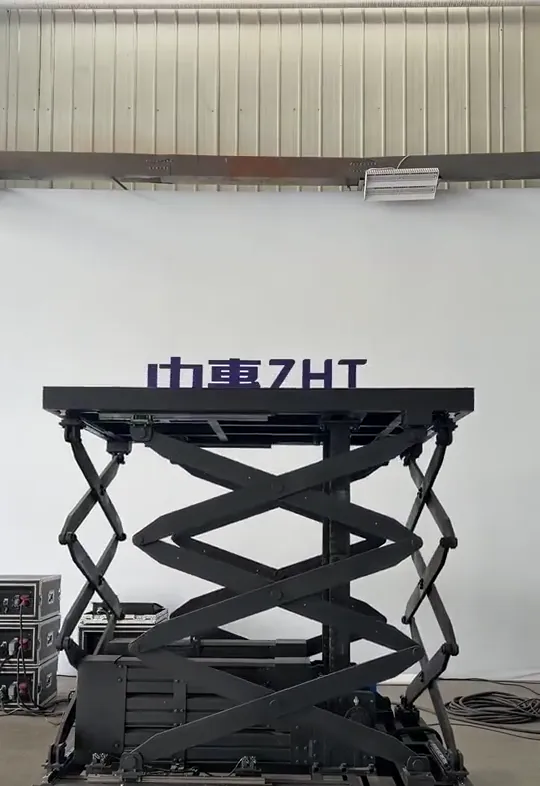
Scissor frame + rigid chain
The scissor frame keeps the platform level; the rigid chain column in the centre lifts it.
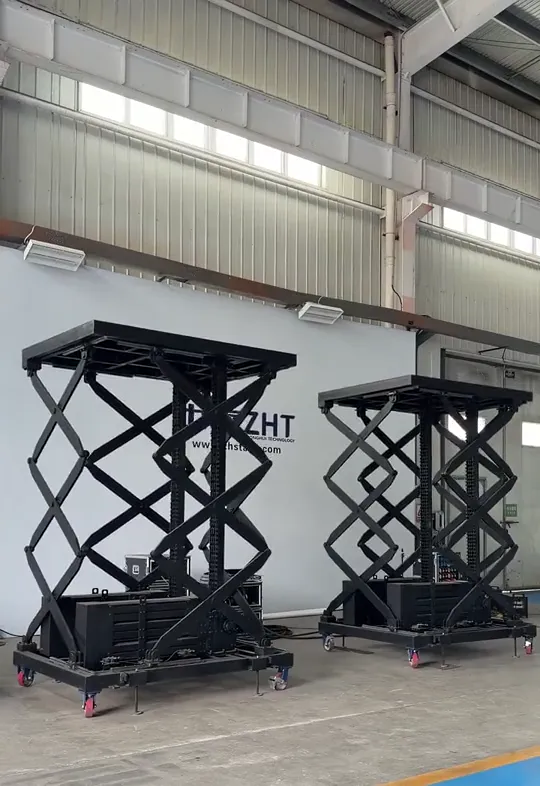
Group run before dispatch
Tables are run singly and in groups so synchronisation can be observed in the factory.
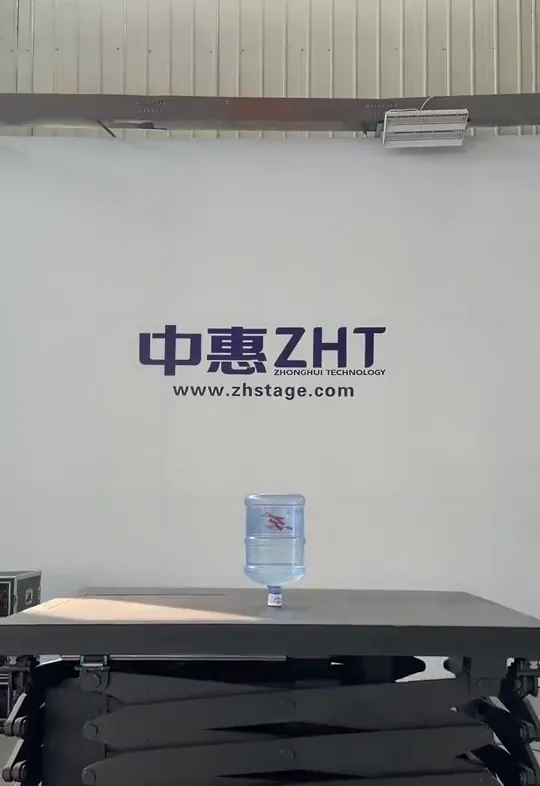
Stability test
A full water bottle stays upright on the platform while the table travels.
Two standard Zhonghui rigid chain lift tables show the range:
| Model | Load | Platform size | Lifting stroke | Min. / max. height above floor |
|---|---|---|---|---|
| SL500 | ≤500 kg | 1450 × 1100 mm | 500 mm | 400 mm / 900 mm |
| SL2000 | ≤1000 kg | 1500 × 2000 mm | 2000 mm | 800 mm / 2800 mm |
The SL2000 travels 2000 mm from an 800 mm closed height, with a standard speed of up to 150 mm/s. Custom platforms are engineered per project; see the rigid chain lift table page.
Reading load and travel together
For rigid chains, the load a chain can carry falls as travel increases, because a taller unsupported column is more sensitive to buckling and side load. Zhonghui therefore publishes each size as two ends of a curve:
| Model | Max. dynamic load / allowed travel | Allowed dynamic load / max. travel | Rated speed | Min. installation height |
|---|---|---|---|---|
| 30A | 8 kN / 1.2 m | 8 kN / 1.2 m | 150 mm/s | 200 mm |
| 35A | 10 kN / 1.5 m | 10 kN / 1.5 m | 200 mm/s | 226 mm |
| 40A | 30 kN / 2 m | 15 kN / 4 m | 300 mm/s | 370 mm |
| 60A | 60 kN / 2 m | 25 kN / 5 m | 300 mm/s | 450 mm |
| 80A | 95 kN / 3 m | 35 kN / 8 m | 300 mm/s | 550 mm |
| 100A | 150 kN / 5 m | 20 kN / 10 m | 300 mm/s | 650 mm |
So a stage lift with a short travel can use a smaller chain per lifting point than one that must travel several metres with the same load. Scissor and hydraulic lifts have their own limits, but they are set by frame geometry and cylinder design rather than by a column curve. Full rigid chain data (static loads, chain weight, pitch, drive weight, rise per revolution) is on the rigid chain systems page; loads and safety design are explained in Rigid Chain Lift Systems: Loads, Safety Design and Testing.
Five questions that decide the drive
- How much depth is there below the stage? If the pit is shallow relative to the travel, a stored-chain design has the advantage over cylinders and long scissors.
- What is the travel? Short strokes favour scissor tables; long strokes favour rigid chain or hydraulic.
- What is the moving load and where can it sit? Include the platform's own weight and the worst-case position (for example a piano at one edge).
- How many lifting points, and how are they kept level? Decide between mechanical shafts and electronic synchronisation with feedback.
- Is hydraulic oil acceptable in the venue? If not, rigid chain or electrically driven scissor designs avoid it.
What to send for a proposal
Send the moving load, required travel, target speed, platform size, available pit depth or installation envelope, number of platforms and how they should be controlled. Zhonghui engineers will compare drive options for your venue and propose a rigid chain configuration where it fits. Request a stage lift proposal — we reply within 24 hours on business days (GMT+8).
Related: rigid chain actuators (30A–100A) · rigid chain lift tables · rigid chain systems · manufacturing